
Books
The Mastery Series.
Five short books. Each takes the research in one area and turns it into ideas, tools, and approaches you can put to use. Where the evidence is thin, I say so.
By T-Michael Dougherty, Ed.D., MPA
Book 1
Focused
Reclaiming attention in a world built to distract you.
How attention works and what fragments it, from the research base up — with tools that protect sustained work in ordinary days.
Focused starts with a week-long record of your own distractions, so the changes you make fit the problems you have. Each method comes with the research behind it, including where that research is limited.
Inside the book
- The 7-Day Distraction Audit: a log of what interrupts you and when, plus an energy map, with five questions that turn the week into your own distraction profile
- What studies show about interruptions and task switching, including Gloria Mark’s finding that interrupted workers took about 25 minutes on average to get back to the task
- The Focus Activation Protocol: four phases, Prime, Plunge, Sustain and Recover, for running a focus session and the break after it
- Phone tactics, and a 7-Day Digital Declutter for the apps you open out of habit
- How alertness changes across the day, and how to plan work sessions and breaks around it
- The early signs of burnout and the kinds of rest that help you recover
- A 30-Day Focus Challenge for turning the methods into habits
- The Focus Toolkit: 11 worksheets you can print or copy into a notebook
The book draws on 63 sources, 51 of them research articles and reviews. Each one is listed in the bibliography with its DOI or publisher.
Available now on Kindle and in paperback
Kindle ebook, $8.99, or free to read with Kindle Unlimited. Paperback, $17.99, available now.
Book 2
Steady
Maintaining inner calm when the world is in chaos.
A practical guide to Stoic philosophy for handling worry, the news, and strong emotions, with the modern research that bears on it.
Steady takes the methods that the Stoic philosophers Epictetus, Seneca and Marcus Aurelius taught for handling difficult events and turns them into short daily practices. Each chapter says which parts come from the ancient writers, which have been studied by psychologists, and which are the author’s own suggestions.
Inside the book
- Three columns for sorting what you face: what is up to you, what you can influence but not control, and what is not up to you at all
- A four-step method for difficult moments: CATCH, DESCRIBE, SORT, CHOOSE
- The 7-Day Control Audit, a week-long record of where your worry and attention actually go
- The Virtue Compass: four questions to ask before a hard decision
- The Daily Practice, a few minutes a day: a morning preview, midday check-ins and an evening review
- Four ways to limit how much of your day the news, apps and social media take
- What research shows about hiding a feeling compared with rethinking the situation that caused it, and the Emotional First-Aid Card
- Four advanced Stoic practices, including negative visualization and the view from above, with safety notes
- A 30-Day Stoic Challenge, and the Stoic Steadiness Toolkit: 10 worksheets you can print or copy into a notebook
The book draws on 33 sources, among them 10 research articles and 9 ancient texts, each cited in a named translation. Every source is listed in the notes.
Available now on Kindle
Kindle ebook, $8.99, or free to read with Kindle Unlimited. Paperback, $17.99, coming soon.
Book 3
Mindset Mastery
Building beliefs that turn consistent effort into mastery.
The research on self-efficacy and belief — Bandura, Dweck, and what has held up since — and the approaches that follow from it.
Mindset Mastery looks at what you believe about your own ability at work and how those beliefs shape what you do after a setback, a mistake or a hard review. It sets out what the research shows, including where the findings are disputed. It is written for working professionals in any field.
Inside the book
- Fixed and growth beliefs about ability: what the research shows and where it is disputed
- Self-efficacy, the belief that you can do a specific task, and how to build it on purpose
- A four-step method for the moment after a setback: SPOT, TEST, REWRITE, ACT
- Learning from mistakes and asking for feedback without concluding that you lack ability
- Impostor feelings, and what the research does and does not know about them
- What changes with age and what does not, and how beliefs about aging affect learning
- How a workplace’s beliefs about talent shape coaching and appraisal, and what you can do in either kind of workplace
- When a job asks too much, and when persistence stops helping
- Beliefs about stress, willpower and emotion that change how people perform under pressure
- Starting again after a lapse, and the beliefs you pass on to colleagues, students and children
Available now on Kindle and in paperback
Kindle ebook, $8.99, or free to read with Kindle Unlimited. Paperback, $17.99, available now.
Book 4
Learn
Evidence-based tools for learning that lasts.
The research on durable learning, including why restudying feels productive while producing little.
Learn covers the study methods with the strongest research behind them and how to fit them into a working adult’s week. Each chapter says when a method works and when it does not.
Inside the book
- How memory works, and why material that feels familiar can still be hard to recall
- Why rereading, highlighting and watching feel more productive than they are, and how to judge your own learning more accurately
- One question to check any study method: “Can I do this without the material in front of me?”
- Recall practice, checking your answers, guessing before you study, and using flashcards and review apps well
- How far apart to space reviews, how to fit them into a working week, and what cramming does and does not do
- When mixing different kinds of problems helps and when it does not
- Making sense of new material, and explaining it to yourself or to someone else
- How learning carries over from a course or study guide to the job, practice that looks like the real task, and practice exams
- When AI tools help you learn and when they do the work in your place, and how to check what a chatbot tells you
- The difference between finishing a course and learning from it, including required continuing education
- A plan for your next month that matches the methods to the learning tasks they suit
- The Learn Toolkit: 11 worksheets you can print or copy into a notebook
Each research claim has a numbered note that gives the complete source.
Available now on Kindle and in paperback
Kindle ebook, $8.99, or free to read with Kindle Unlimited. Paperback, $17.99, available now.
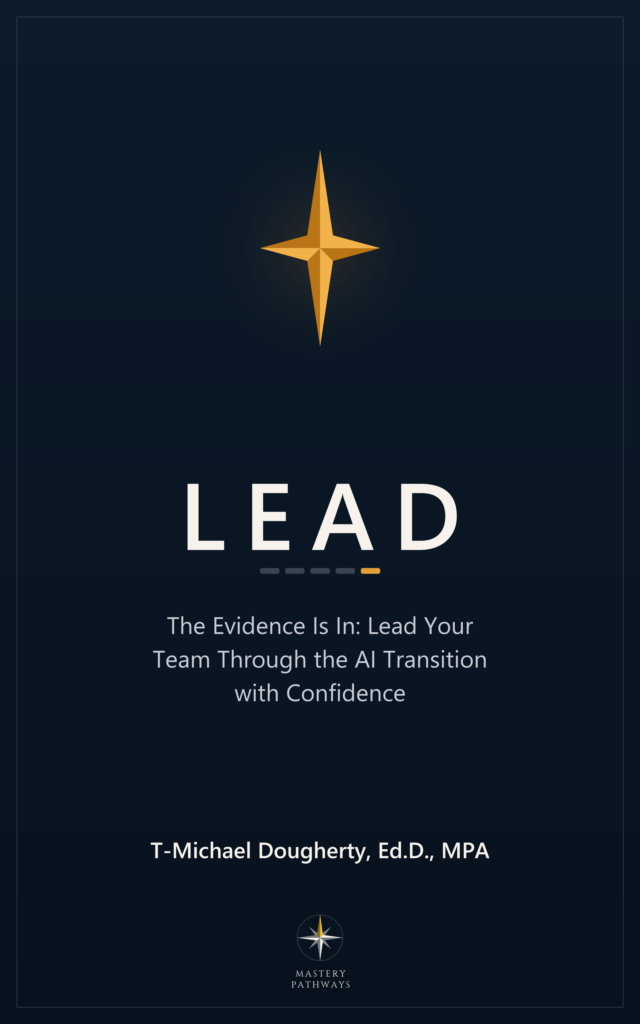
Book 5
Lead
Leading a team through the AI transition, and what makes adoption stick.
How teams actually adopt new tools, and the leadership practices that make adoption stick — applied to the AI transition.
Available now on Kindle and in paperback
Kindle ebook, $8.99, or free to read with Kindle Unlimited. Paperback, $17.99, available now.
Read Chapter 1 of Focused, free.
Enter your email address and the first chapter comes to your inbox as a PDF. Tick the box if you also want to hear when the next books in the series are released.
FREE CHAPTER
Read Chapter 1 of Focused, free.
Enter your email address and the first chapter of Focused comes to your inbox as a PDF: what researchers have learned about how attention works in the brain.
Unsubscribe at any time. Your information is never sold.